
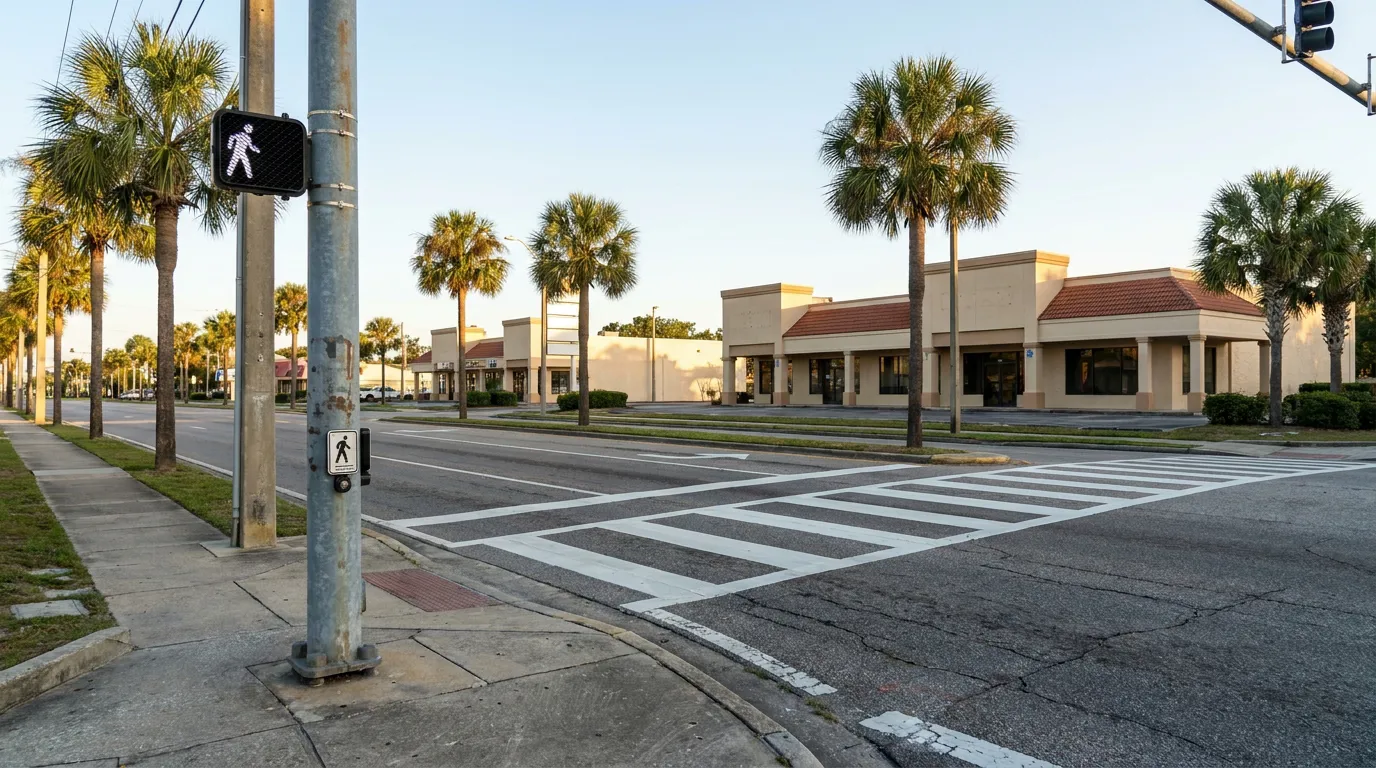
When a Pensacola Crosswalk Turns Into a Legal Fight
Key Takeaways: Under Florida law, liability for a Pensacola pedestrian accident typically begins with the at-fault driver but can extend to the vehicle’s owner, multiple parties under comparative fault, and your Uninsured Motorist coverage when a driver flees. Fault requires proving negligence through four elements: duty, breach, causation, and damages. Florida’s no-fault system means your PIP coverage pays medical bills regardless of fault, but you must seek care within 14 days and generally need an emergency medical condition diagnosis for full benefits. Under modified comparative fault, damages are reduced by your share of blame, and for accidents on or after March 24, 2023, being more than 50% at fault eliminates recovery entirely. Bodily injury liability coverage is generally optional in Florida, making it critical to identify every liable party and policy.
If you were hit by a car while walking in Pensacola, the person who caused the crash is usually responsible for your injuries, but Florida law makes the answer more complex. Liability can rest with the driver, the vehicle owner, multiple parties, or even come through your own insurance if the driver flees.
We are the Law Office of JJ Talbott, a small Pensacola team where you talk directly to JJ, not a call center. If you were hurt and are not sure who is liable, reach out to the Law Office of JJ Talbott, call us at (850) 437-9600, or send a message through our contact page.
How Florida Decides Who Is at Fault in a Pedestrian Accident
Fault in a Pensacola pedestrian accident comes down to negligence, which is a failure to use reasonable care that results in harm. A driver who was not careful and injured you may be legally responsible. This is the foundation of nearly every pedestrian accident liability claim in Florida.
The law expects drivers to operate vehicles with reasonable care toward pedestrians. This duty is the starting point courts use to measure whether a driver became liable for your harm.
The Four Things You Have to Prove
To hold a driver responsible, you must prove four elements:
- Duty of care: the driver owed you a legal obligation to drive safely.
- Breach of duty: the driver failed to meet that obligation.
- Causation: that failure actually caused your injuries.
- Damages: you suffered real, measurable losses.
💡 Pro Tip: Start a folder the day of the crash with photos, the crash report number, witness names, and medical records, these prove causation and damages when the insurance company starts asking questions.
Common Ways Drivers Break Their Duty
A breach of duty often involves speeding, distracted driving, or failing to yield at a crosswalk. A driver looking at a phone instead of the crosswalk, or rolling through a turn without checking for foot traffic, establishes fault.
Florida’s No-Fault System and Your First Layer of Coverage
Florida is a no-fault state, which shapes how you get paid before anyone proves fault. If you own a motor vehicle with four or more wheels, you must carry $10,000 of personal injury protection (PIP) insurance and $10,000 of property damage liability insurance. PIP is the first layer of coverage when a pedestrian is hit.
PIP pays your medical expenses regardless of who caused the accident. It covers you up to $10,000 minus your deductible when a qualifying provider determines you have an emergency medical condition (EMC); without an EMC diagnosis, PIP medical benefits are capped at $2,500.
But there is a hard deadline: To be entitled to PIP benefits, you must receive initial medical care within 14 days after the accident. Miss this window and you forfeit your PIP claim.
💡 Pro Tip: Even if you feel "okay," get checked within 14 days. Adrenaline hides injuries, and early documentation protects your health and claim.
When More Than One Party Shares the Blame
Liability doesn’t always stop with the driver. It can extend to the vehicle owner who gave permission to use it. Coverage may include anyone who uses the car with permission and can pay for injuries caused by relatives driving someone else’s vehicle.
Bodily injury liability coverage, which pays for serious injuries when a driver is at fault, is generally optional in Florida. That gap can complicate recovery, making it critical to identify every liable party and policy.
| Coverage Type | Who It Protects | Required in Florida? |
|---|---|---|
| Personal Injury Protection (PIP) | You, regardless of fault | Yes, $10,000 minimum |
| Property Damage Liability | Others’ property you damage | Yes, $10,000 minimum |
| Bodily Injury Liability (BIL) | People injured by an at-fault driver | Generally not required |
Comparative Fault and How Damages Get Split
Florida no longer uses joint and several liability in most negligence cases. Effective April 26, 2006, section 768.81, Florida Statutes, was amended to apportion damages according to each party’s percentage of fault. Under this Florida negligence claim and apportionment rules approach, a party’s liability is generally limited to its own degree of fault.
Florida’s comparative fault rule changed again in 2023: On March 24, 2023, House Bill 837 converted Florida to a modified comparative negligence system, adding a 51% bar, if you are more than 50% at fault, you recover nothing. This applies to accidents on or after March 24, 2023; earlier accidents follow the old "pure" rule without the 51% bar.
💡 Pro Tip: Never admit fault at the scene or in a recorded statement. Comparative fault means anything you say can shift blame onto you, directly reducing your recovery.
Hit-and-Run and Uninsured Drivers: You May Still Have Options
If the driver fled, you are not out of luck. Under Florida law, drivers must stop immediately at any crash resulting in property damage, injury, or death. The Aaron Cohen Life Protection Act, section 316.027, Florida Statutes, imposes a mandatory minimum of four years for leaving the scene of a fatal crash.
Even when a hit-and-run driver is never found, you may still recover. Many auto policies include Uninsured Motorist (UM) coverage for your damages. Review your policy soon after a crash.
Why a Personal Injury Attorney in Pensacola Can Make the Difference
Handling a pedestrian claim alone against an insurance company is rarely a fair fight. JJ has spent 26-plus years practicing here and knows the local courts, judges, and insurance adjusters. When you call us, you get JJ personally, not an inexperienced associate.
We give honest assessments, even when the answer is not what someone hopes to hear. That plain-spoken approach is what our neighbors have trusted across our range of Pensacola personal injury lawyer matters.
💡 Pro Tip: Insurance companies often call quickly with a low offer. Politely decline to give a recorded statement until you speak with an attorney who can explain what your claim may actually be worth.
When a pedestrian accident turns fatal, the family still has legal paths forward. Surviving family members may recover through a wrongful death claim, while the estate can pursue a survival action for medical bills and pre-death pain and suffering.
Frequently Asked Questions
1. Can I still recover money if I was partly at fault for the crash?
In many cases, yes. Under modified comparative fault, if you are 50% or less at fault, your recovery is reduced by your percentage. However, for accidents on or after March 24, 2023, being more than 50% responsible bars recovery entirely.
2. What happens if the driver who hit me had no insurance?
You may still recover through your own Uninsured Motorist coverage. Not every policy includes UM, so check yours. We can help you understand what it covers.
3. How soon do I need to see a doctor after being hit?
Seek care within 14 days to stay eligible for PIP benefits. Missing this window cuts off important coverage. Prompt treatment also strengthens the connection between the crash and your injuries, and an emergency medical condition diagnosis unlocks the full $10,000 rather than the $2,500 cap.
4. Who can be held liable besides the driver?
Liability may extend to the vehicle’s owner if they gave permission to drive. In fatal cases, wrongful death and survival claims involve the family and estate. Identifying every responsible party builds a full claim.
5. Is a PIP claim the same as suing the at-fault driver?
No. PIP is a no-fault benefit that pays bills regardless of who caused the crash, while a liability claim holds the at-fault party accountable. The two are separate. For more, our pedestrian injury compensation resources address common questions.
Putting It All Together After a Pensacola Pedestrian Crash
Liability for a Pensacola pedestrian accident typically starts with the at-fault driver but can reach vehicle owners, multiple parties under comparative fault, and your own UM coverage in a hit-and-run. PIP gets bills paid fast, the 14-day rule protects that access, an emergency medical condition finding determines whether you reach the full $10,000, and proving duty, breach, causation, and damages ties a negligent driver to your losses.
You do not have to figure this out while hurt and stressed. Call the trusted personal injury attorney in Pensacola team at (850) 437-9600, reach us through our free consultation request, or learn more at the Law Office of JJ Talbott. Call us today for a free consultation, and we will tell you honestly where you stand.